Evolving houses with Homemaker
This is a brief article that tries to answer some common questions asked about this project, mostly answering what it can do and what it can’t do.
If you want more detail, there are three further articles: one discussing the relevance of Pattern Languages to the project; another describing the approach taken by the software; and a final article describing why the world needs this.
What is Homemaker?
Homemaker is a software tool for designing houses and other domestic buildings. It works already, though it isn’t finished. It is Free Software.
It does everything from first principles; there are no template buildings or ready-made designs, it takes a plot of land and uses evolution to fit it with the best house it can. It works by adding rooms and floors one by one, mixing them together, improving the design through a process of adaptation.
All you have to do is: 1. describe your site geometry, 2. tweak your preferences for sizes, rooms and such like, 3. run the software, 4. wait a long time (or use more computers).
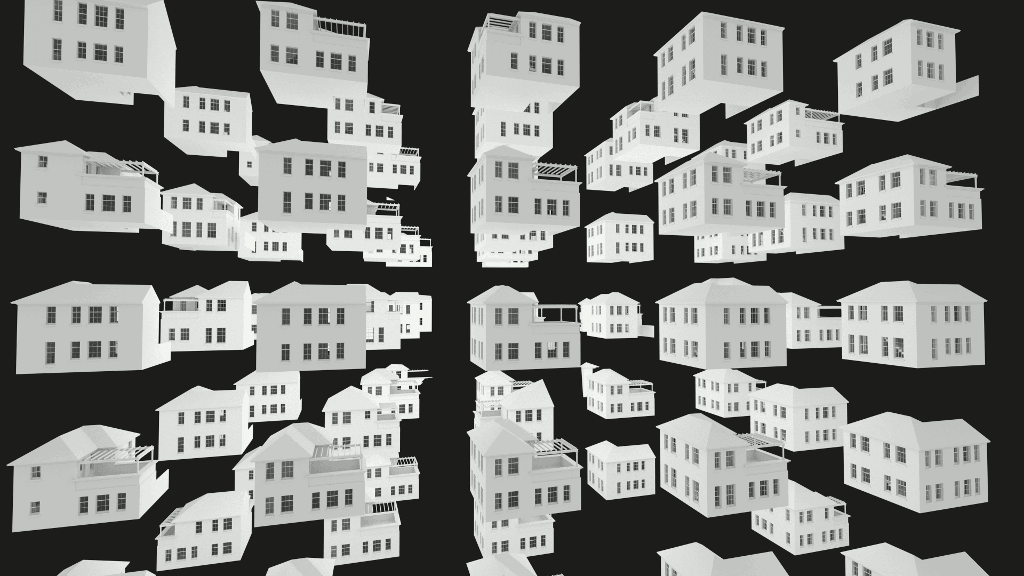
More than that, you can use Homemaker to design multiple houses at the same time, these houses will integrate with each other in terms of shared daylight. It can do this because at every stage of the process a daylight field is calculated and the buildings optimise themselves to fit this field — see Growing buildings in a daylight field for what that feedback loop actually produces.
Why?
The background to all this is a realisation that everyday domestic architecture sucks. Somebody has to do something to raise the quality of building design - and making tools available for everybody and anybody to be able to design their own is one way to start making this happen.
There is also an ecological imperative to rediscover the ability to design good quality, efficient, compact houses that take up less space in the world.
What can and can’t it do?
It designs domestic scale buildings, basically buildings that have what is usually described as ’load bearing wall’ construction. It doesn’t design using the kind of regular grid that you would see in a ‘post and beam’ construction,
It fits buildings to plots, so it isn’t much use in unbounded situations - if you want a detached house in a large suburban plot, you are better off reusing an existing design.
Buildings are custom fitted at every scale; such a system doesn’t repeat the same floor plan at every level like an apartment block, or repeat a series of identical buildings in a row. It won’t give you a row of identical houses even if you give it a row of identical plots to work with.
Don’t expect it to design cinemas, shopping malls, churches, or factories - very large-span, open-plan building types don’t fit the load-bearing-wall, subdivided form language this software is built around, whatever the room programme. But it’s no longer limited to plain housing the way it once was: an optional ‘programme-driven’ mode lets you define an arbitrary mix of room types, target sizes and required adjacencies - a shop next to a flat, a workspace next to a kitchen - and evolve a building to fit that specific mix, instead of only ever producing the generic room mix the original mode assumes. See the Software Overview for how this works.
Can I use it to design my own house?
Yes of course, this is Free Software, you can also use it to design other people’s houses. Development isn’t finished, so expect some rough edges, if you are comfortable installing command-line and server-side software then you shouldn’t have too many problems.
Can I help?
Yes! There is lots that needs to be done.
Next
- The next article in this series shows how Pattern Languages fit in
- After that there is a brief description of how the software works
- The final article develops the reasoning behind why we should do this
- There is some in-depth raw source material collected as Fragments (not yet part of this site)

© 2014 Bruno Postle (mail: bruno at postle dot net, twitter: @brunopostle). This work is licensed under a Creative Commons Attribution 3.0 Unported License.
Last updated 12 November 2018.