Homemaker add-on and homemaker-web
Everything in Software that evolves houses and the Software Overview is hands-off: describe a site, wait, get a building. homemaker-addon and homemaker-web are the interactive counterpart — the same form language and the same industry-standard IFC output, but human-driven instead of evolved. Their own tagline puts it plainly: design buildings the pointy-clicky way.
The Blender add-on
Draw walls and floors as ordinary flat 3D faces — the only rule is that walls are vertical and floors are horizontal, and the faces need to overlap enough to define a cell for each room. The add-on reads that mesh, works out where the actual rooms and walls are, and turns it into a fully compliant IFC (BIM) model: real wall, floor, roof, window and door entities, styled and ready to take toward construction.
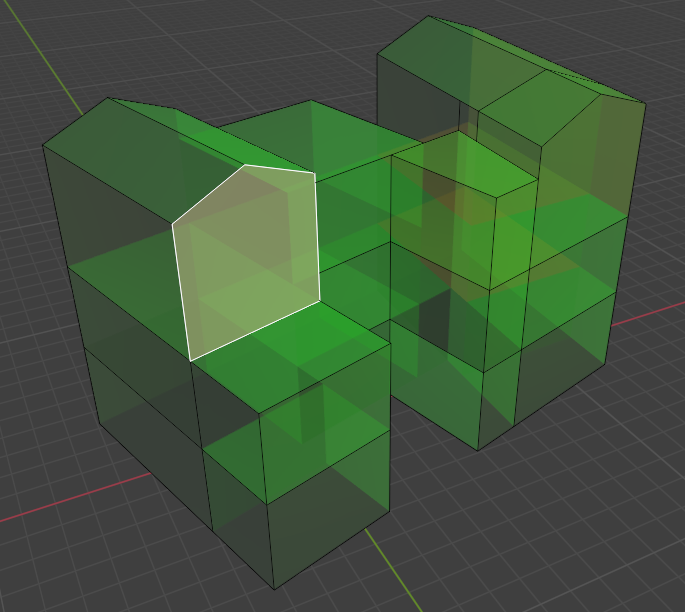
Figure: A Blender mesh where walls and floors are drawn as simple overlapping faces
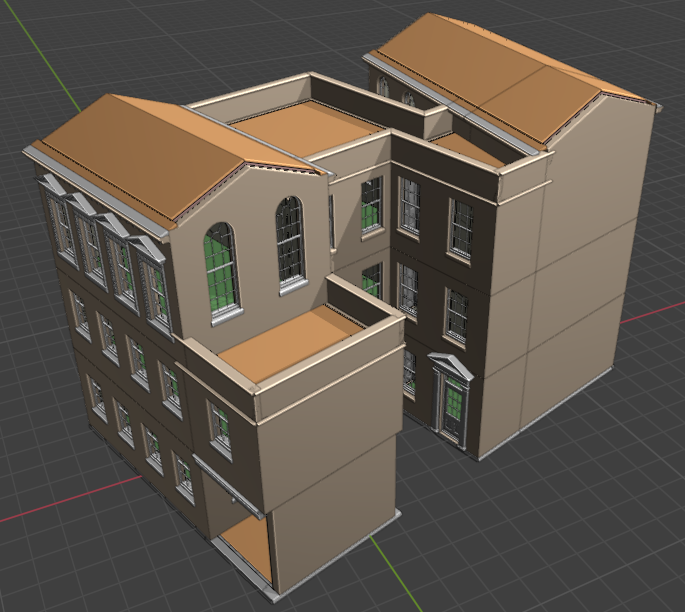
Figure: The same mesh, one click later — a styled IFC building with roofs, windows and mouldings
It grew out of the 2021 “Topologise” experiments — using the Topologic library to identify a mesh’s external and internal walls inside Blender — which matured, over the following months, into a complete rewrite: the entire Perl backend was replaced with a 100% Python pipeline built on Topologic and IfcOpenShell, styled through the Bonsai BIM Blender add-on. The style system carried over from the original Perl Molior library, inheritance and all — the same courtyard Arab/Mediterranean-influenced style mentioned in the Homemaker walkthrough still exists here, alongside newer styles with names like foxhouse and halifax.
One nice piece of continuity: the crinkliness measure — the external-wall-to-floor ratio argued to be equivalent to 159 LIGHT ON TWO SIDES OF EVERY ROOM — isn’t just theory here, it’s an actual feature: each generated room is colour-coded by its own crinkliness score, so a design’s fit to that pattern is visible at a glance rather than buried in a report.
The library also generates IFC structural-analysis data and second-level space-boundary data for thermal analysis, though both still need testing against real analysis software rather than being a finished, validated pipeline. And one thing was honestly lost rather than carried over in the Perl-to-Python rewrite: circulation and stair management, which the project’s own roadmap lists as needing to be reimplemented. FreeCAD support - the add-on’s Python core isn’t tightly bound to Blender - is a stated goal, not yet a shipped feature.
homemaker-web
A second front end to the same underlying library, with no Blender required at all: a 3D room editor running entirely in the browser (Three.js), where you draw and reshape rooms as quadrilateral prisms, drag corners to make them non-orthogonal, assign a usage (bedroom, kitchen, circulation, …) and a style per room or per individual face, with full undo/redo and autosave to the browser’s own storage. A small Python server wraps the same molior/topologist library behind a plain HTTP API and regenerates a live IFC model in the background as you work — shown ghosted in the same 3D scene while it catches up, solid once it’s done.
The only thing standing between this and running entirely client-side is topologic_core, a C++ extension with no WASM build yet; the project’s own JSON geometry API is deliberately designed as the replacement boundary for whenever one appears.
Where this fits
Both tools are explicit about the relationship to the rest of this project: they build on the evolutionary engine’s proof that Pattern Languages form a workable theory of architecture, but supply the interactive design tool that a fully automated evolution engine doesn’t. Their own roadmap states the underlying motive as directly as anything on this site does: “let’s take architecture out of the hands of architects and put it back in the hands of people who need good ordinary buildings.”
Source: github.com/brunopostle/homemaker-addon (web/ in that same repository holds homemaker-web). Reference and API documentation: homemaker-addon.readthedocs.io.

© 2026 Bruno Postle (mail: bruno at postle dot net). This work is licensed under a Creative Commons Attribution 3.0 Unported License.
Last updated 15 September 2026.